BESS3, BESS4 and BESS5 Mean for Your Property
If you've been waiting for the right time to add a battery to your solar system — or you manage an apartment building, a business premises, or an industrial site — this is worth reading.
From 1 September 2026, three new incentive pathways open up under the PDRS (Peak Demand Reduction Scheme), alongside the residential and small business rebate that's already live. Here's what's changing, and what it could mean for your energy costs.
What's Already Available Right Now
Homeowners and small businesses can currently access rebates through Virtual Power Plant (VPP) onboarding. In practice, that can mean a meaningful reduction in the upfront cost of a battery, plus ongoing credits for letting your battery support the grid at peak times. If you've been quoted for a battery recently, it's worth asking whether this has been factored in — it often makes a real difference to the numbers.
What's Launching on 1 September
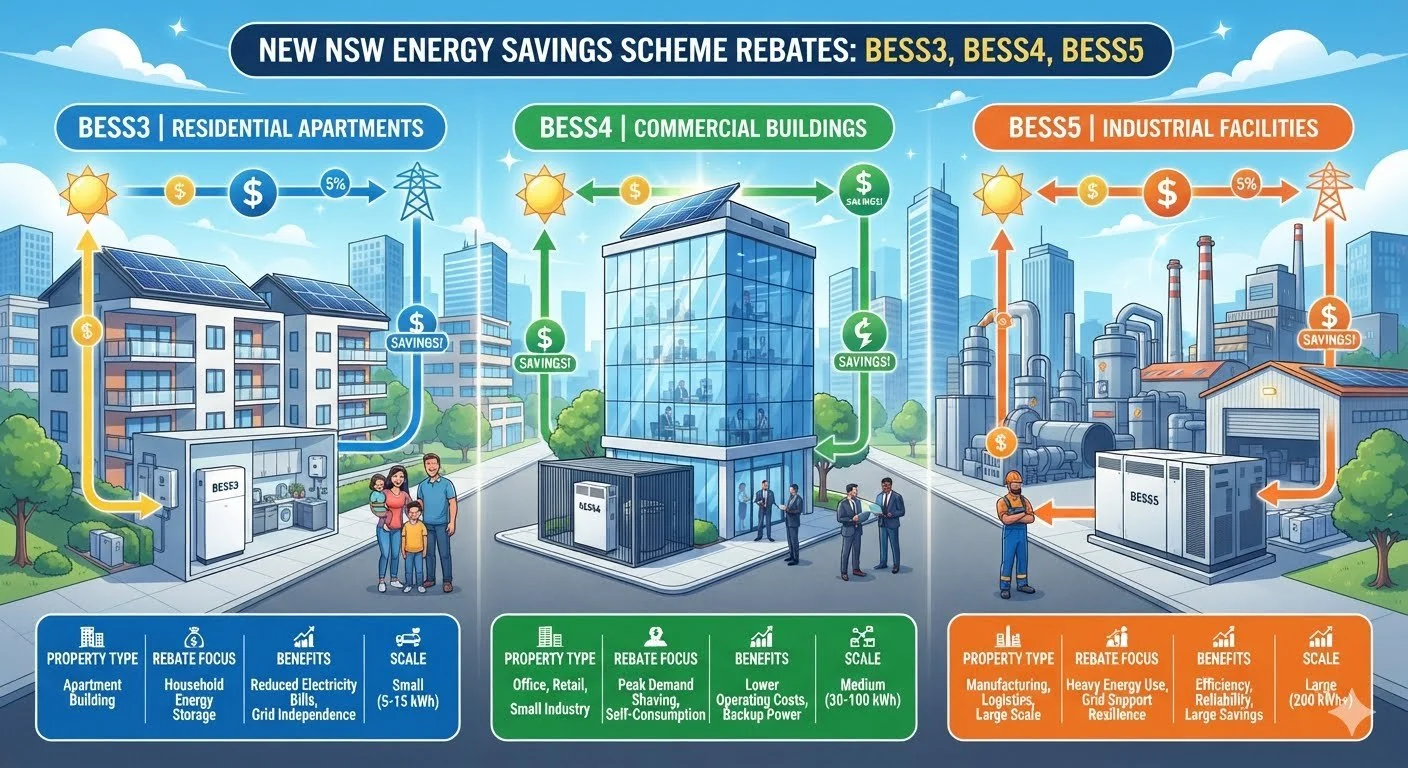
Apartment buildings (4+ units): A new pathway opens up for Class 2 buildings — think unit blocks and multi-dwelling developments — to install shared battery storage. This has historically been a gap in the incentive landscape, so it's a genuine opportunity for owners corporations and strata committees to lower common-area and shared energy costs.
Small-to-medium businesses: Systems in the 20–200 kWh range become eligible for a dedicated incentive pathway. If your business carries high peak-demand charges — the kind that spike your bill during your busiest hours — this is aimed squarely at bringing that down.
Large commercial and industrial sites: For bigger operations, storage from 200 kWh up to 30 MWh will be eligible, opening the door to serious peak-demand and cost-management strategies at scale.
Write a blurb about .
The Bonus Worth Knowing About
Across the new commercial pathways, pairing solar with a battery — rather than installing a battery alone — attracts a noticeably higher incentive, provided the system meets the required solar-to-battery sizing ratio. For apartment buildings and commercial sites alike, this makes bundling solar and storage together the more financially sensible move for eligible properties.
Why It's Worth Planning Now, Not in September
Apartment, commercial and industrial projects generally need council planning approval before work can begin. That approval process takes time — so starting the scoping and paperwork now means a project can be ready to go the moment the rebate opens, rather than starting the clock from scratch in September.
Talk to Us
Whether you're a homeowner considering a battery, a strata committee looking at shared storage, or a business trying to get on top of peak demand charges, we can walk you through what you're eligible for and what it's worth in real terms.
Coast Wide Energy is a Brighte-accredited installer serving the Central Coast, Newcastle and Mid North Coast. Get in touch to find out where you stand.
Rebate amounts, eligibility criteria and timelines are subject to change under the PDRS scheme. Figures above are general guidance — contact us for a quote based on your specific property and current incentive terms.
Anthony Mifsud
Coast Wide Energy